

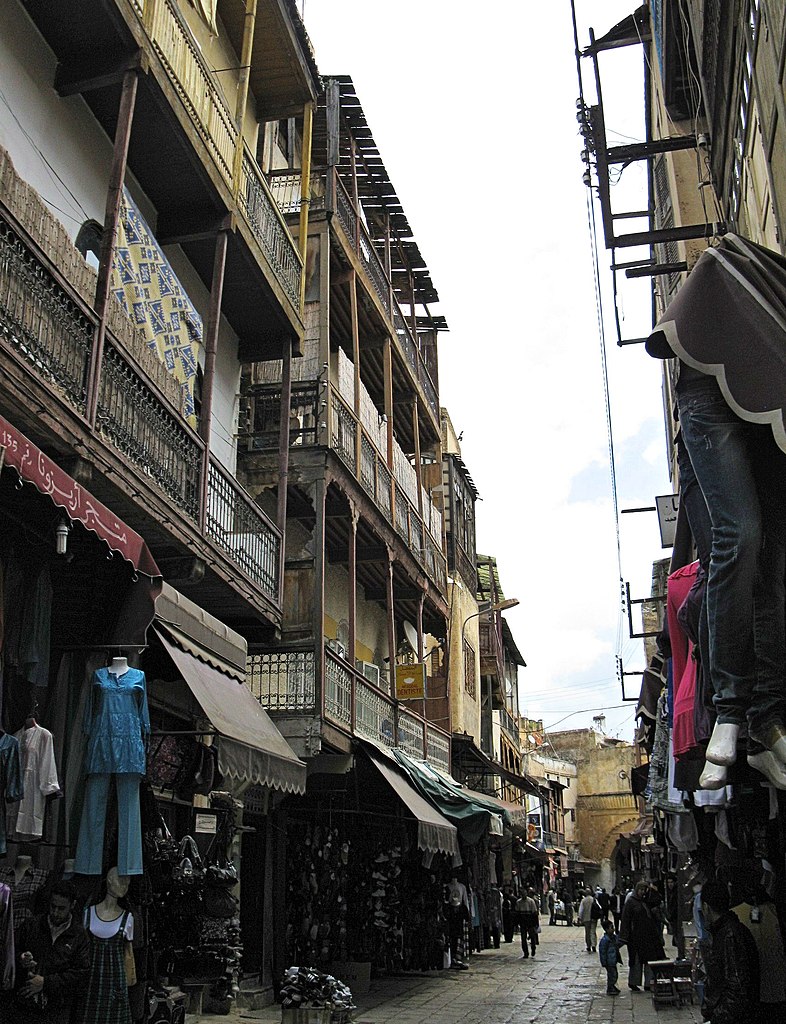
The Mellah is made up of houses standing close to one another, different in height, size, and character. Behind each door is a different story. Some families have lived here for generations; others arrived because life brought them here. Inside these homes, as everywhere, there is hope, love, disagreement, hardship, laughter, and the ordinary complexity of family life.
Outside, every available corner can become something else. For children and young people, a small square or an empty space between houses becomes a football field, a playground, or sometimes a wrestling arena when disagreements break out. Women meet their neighbors and exchange news about daily life, their families, what happened yesterday, and what everyone in the neighborhood is talking about.
By noon, the sound of pressure cookers can be heard from the houses, and mothers begin calling their children for lunch. Then, for a while, the streets become quieter. Children are at school, many adults are at work, and some of the elderly take their afternoon nap.
The calm does not last forever. The school bell rings, children return, and the neighborhood becomes animated again. In summer come the voices of ice cream vendors; in winter, sellers of hot chickpeas. Small shops open onto the streets, and groceries, clothes, bread, food, and everyday services form
part of an informal economy that keeps the neighborhood moving. Women participate in this economy alongside men, preparing food, selling bread and small goods, and contributing to the life of their families and neighborhood.
There is hardship in the Mellah, and life here is not always easy. But reducing the neighborhood to poverty would mean missing much of what gives it its character. The Mellah is also a cultural and historical space, shaped by generations of people who lived, worked, prayed, celebrated, cooked, traded, argued, raised families, and built communities within its streets.
Children growing up here today may dream of becoming football players, doctors, hair stylists, entrepreneurs, or simply of discovering a different life. Some will remain. Others will eventually leave. Yet, for many, the streets where they grew up will continue to be part of their memory.
And they are not the first generation to experience this relationship with the Mellah.
Before many of today's inhabitants arrived, Jewish families filled these same streets with their own rhythms of everyday life. The Mellah was home to merchants and craftsmen, rabbis and teachers, mothers and children, wealthy families and families of modest means. Hebrew prayers could be heard inside synagogues, while Moroccan Arabic and Judeo-Arabic filled homes, shops, courtyards, and markets.
Traces of that history are still there. They can be found in synagogues and the white tombstones of the cemetery, in architecture and street names, in old shops and family stories, and sometimes in details that people pass every day without knowing the stories behind them. The Mellah is therefore not simply an old Jewish neighborhood, nor is it only the neighborhood of those who live there today. It is a place where different periods of Moroccan history occupy the same streets.
Its location within the city also tells a story. Mellahs were places of commerce, craftsmanship, religious life, family networks, and interaction with the wider city. Their history speaks not only about Moroccan Jews, but about the relationships between Jewish and Muslim Moroccans and the urban culture they helped shape together.
Today, the population has changed and many of the old Jewish families live elsewhere, in other Moroccan cities and across the world. New families have made these houses their homes and added their own memories to the neighborhood.
This is perhaps what makes the Mellah so interesting. It is neither frozen in the past nor disconnected from it. It is a living neighborhood carrying several generations of Moroccan memory at once. The Mellah continues to change, as it always has. Its value lies not only in the buildings that survive or the memories of those who left, but also in the people who inhabit it today. Past and present do not have to compete here. Together, they tell the continuing story of a Moroccan neighborhood that has belonged to many generations and still has many stories left to tell.
.svg)


.svg)
.svg)
.svg)


.svg)
.svg)